

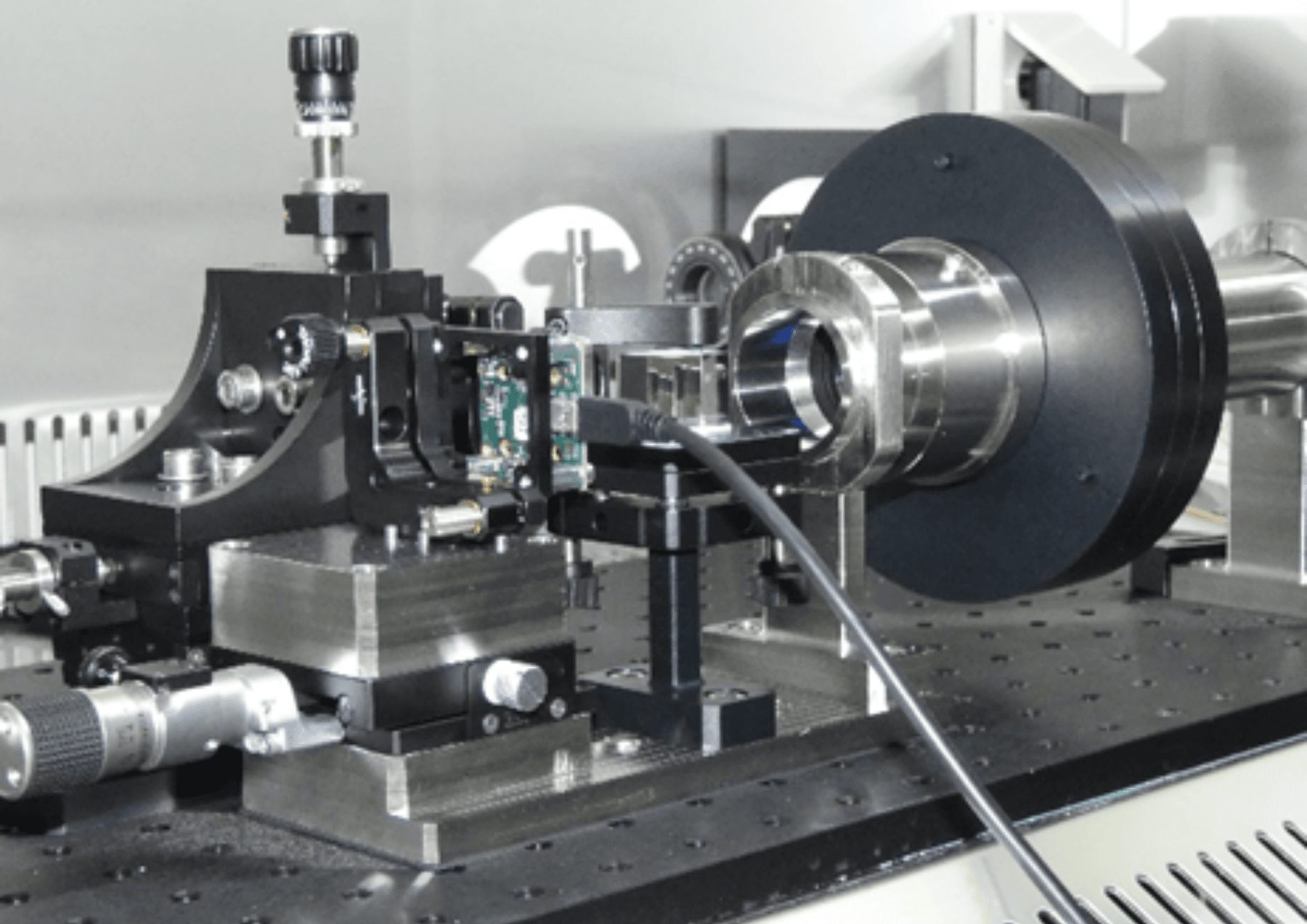
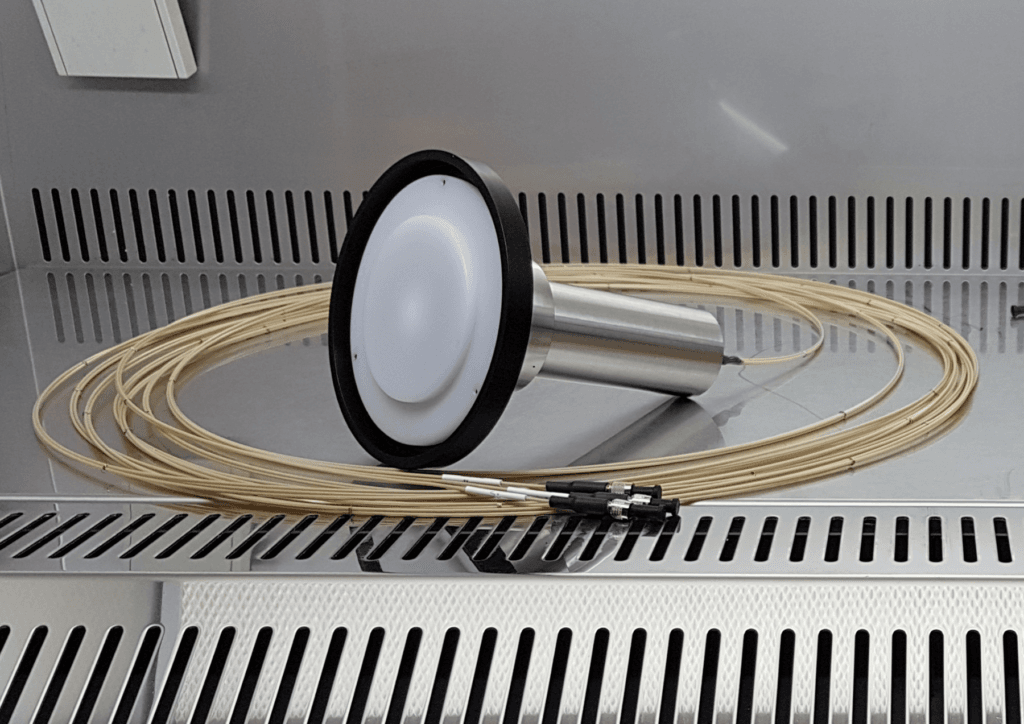
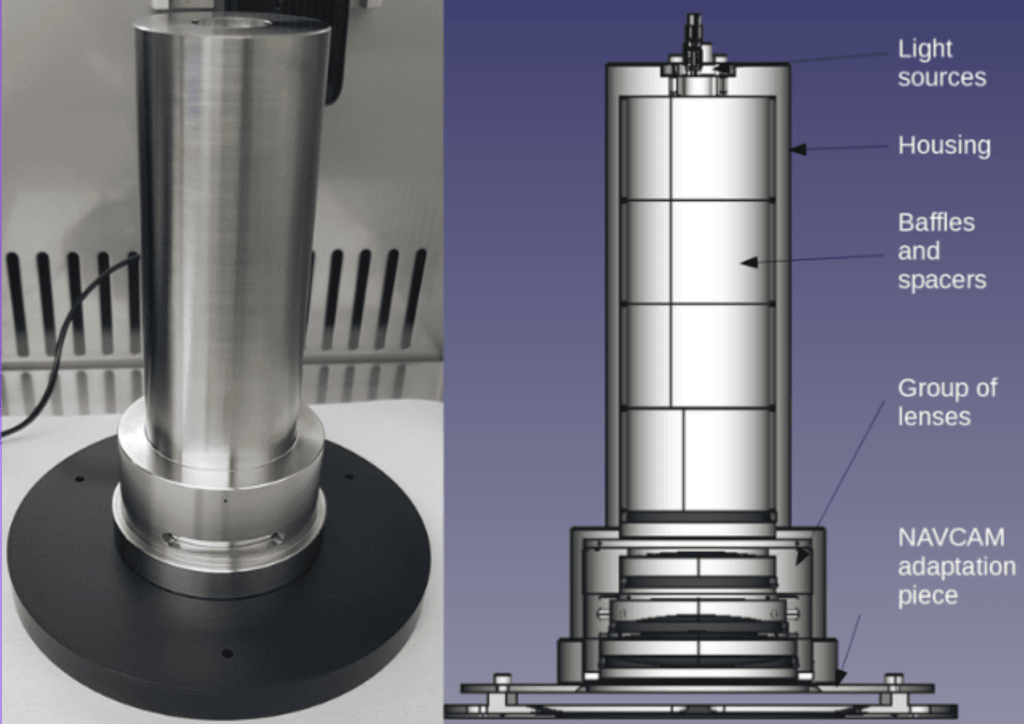
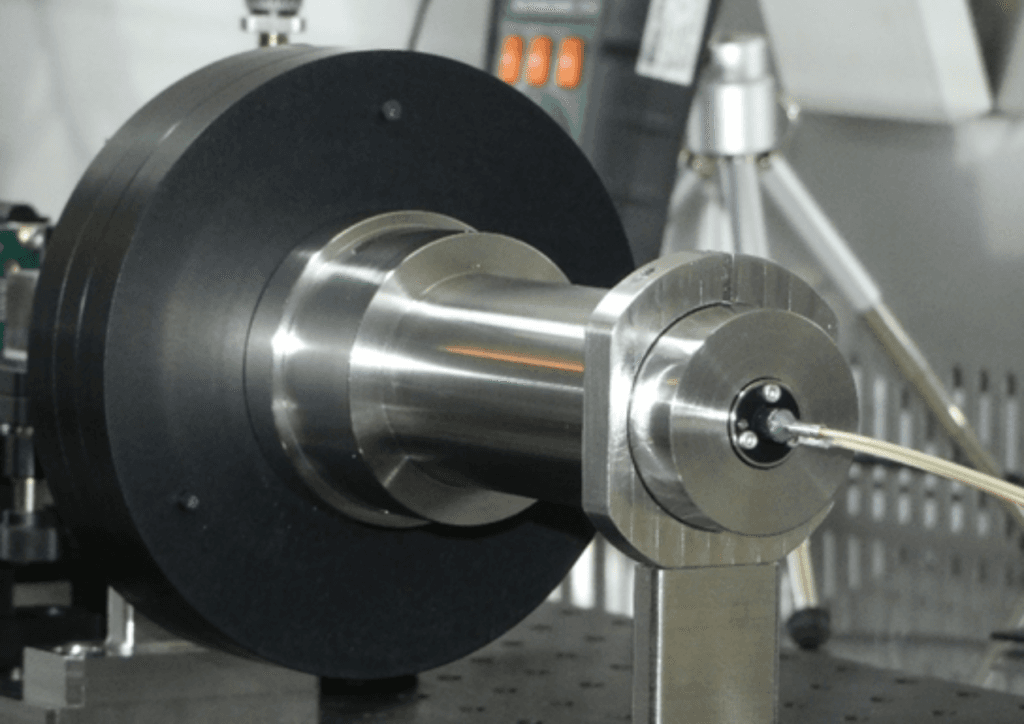
Photonics Applied to Space: An Artificial Sky for Space. Arlumen designed and built an optical star simulator. It enables very precise adjustment of a space probe’s navigation camera. The simulator consists of a Simulator Electronic Box (SEB) and a Stars and Moons Simulator (SMS). The SEB includes a custom-designed circuit board that powers three high-dynamic-range, high-stability fiber-optic LED light sources. The SMS is equipped with custom-designed optics intended to collimate the light from the three fibers connected to the SEB.
Simulating the moon and stars to test the JUICE probe's camera
Before launching the JUICE probe to Jupiter, Sodern needed to qualify its navigation camera, which is essential for navigating between planets and tracking its trajectory by observing moons and stars. Arlumen served as an expert optics partner to design, integrate, and optimize the moon and star simulator, enabling the camera to be qualified prior to launch under conditions identical to those in space.
The goal: To design a moon and star simulator that accurately replicates real-world space conditions
Technological challenges
To qualify the JUICE probe’s camera, it was necessary to recreate a space-like environment in the laboratory that was subject to various constraints:
- Low outgassing: The tests were conducted in vacuum chambers to accurately replicate space environment conditions, requiring the use of materials that do not emit gases or particles.
- Stray light reduction: Simulating a dark sky requires minimizing stray light to ensure high contrast between the sky background, the stars, and the moons.
- Thermal constraints: A thermal-insulated design that enables the simulator to meet the required specifications over a wide temperature range (-40 to +70°C), similar to the conditions encountered in space.
- Realistic optical simulation: faithful reproduction of stars and moons with controlled uniformity and sharp edges.
Solution designed by Arlumen
- Design of a compact simulator connected to the camera housing, capable of reproducing a dark sky with stars and moons, and equipped with three fiber-optic LED light sources (625 nm).
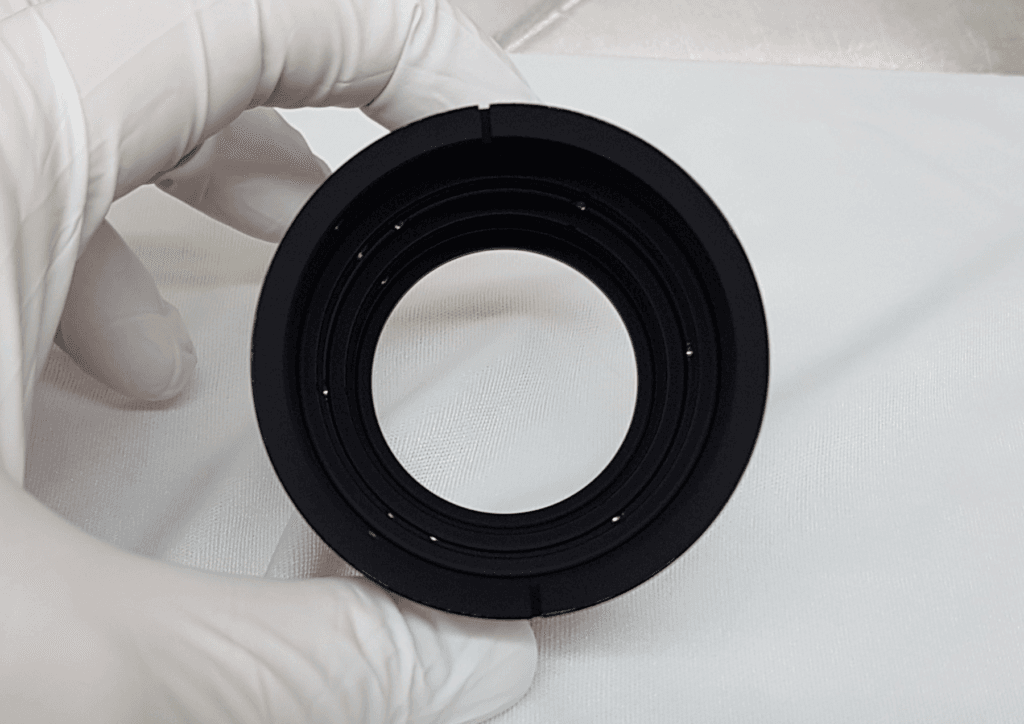
- Incorporation of an absorbent interior coating that ensures a dark sky effect, high contrast, and minimal stray light.
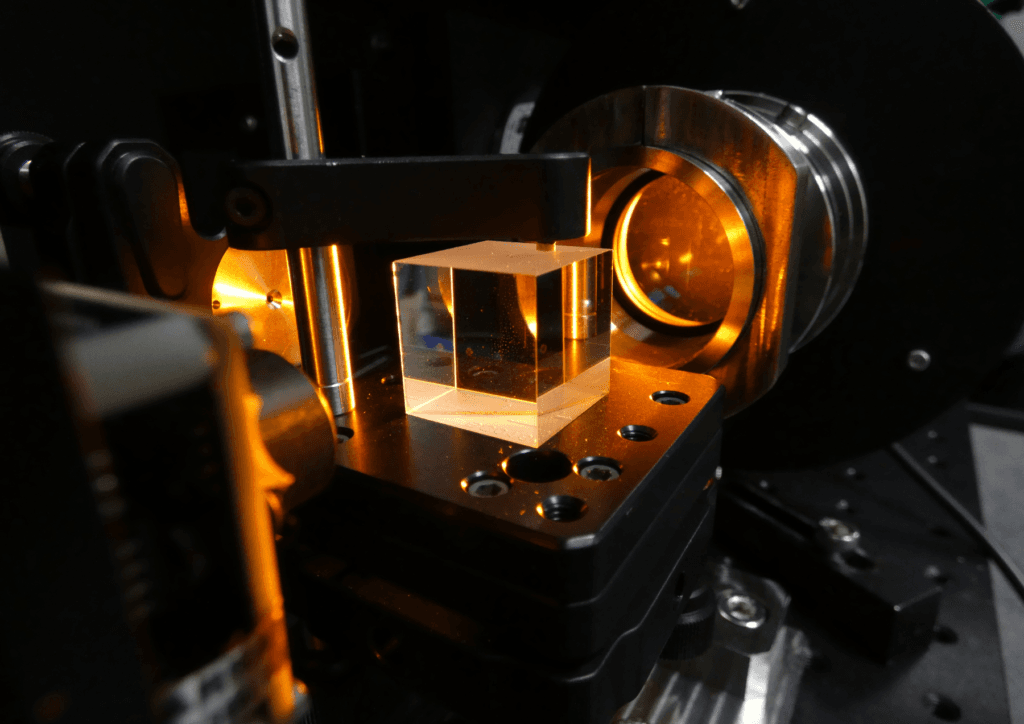
- Development of custom-made lenses from high-quality optical glass (Class 1) with a low inclusion rate to minimize light diffraction.
- Implementation of a titanium mount with low heat dissipation and high mechanical stability to minimize outgassing and dust in near-vacuum environments.
- Development of a user interface that allows users to control the six light source modes manually or via software, with power indicators for the moons and stars.
Achieved performance
- Accuracy of the star's luminous flux: ±0.2 × 10⁻¹⁰ W·m⁻²
- < reflectance of 0.25% in the target spectral band
- Stray light < s 0.05% of the stars' field of view
- Operational simulator from -40°C to +70°C with relative humidity <, 70%


