AzurIA is a French company based in the south of France. It develops algorithms and sensors incorporating Artificial Intelligence to detect high-risk natural events and provide real-time warnings.
As part of an Econum project sponsored by the French Environment and Energy Management Agency (ADEME), AzurIA asked Arlumen to study the mechanical, optical and thermal design of their CamIA multispectral camera. This intelligent detection and warning system features an on-board AI that detects natural hazards and dangerous situations (fire, rescue at sea, marine pollution, etc.).
The advantage of the solution deployed by AzurIA is that it directly integrates its AI recognition algorithm into the system. As a result, detection takes place in real time, and alerts are transmitted to emergency services in (near) real time via Wifi/mobile network/Ethernet.
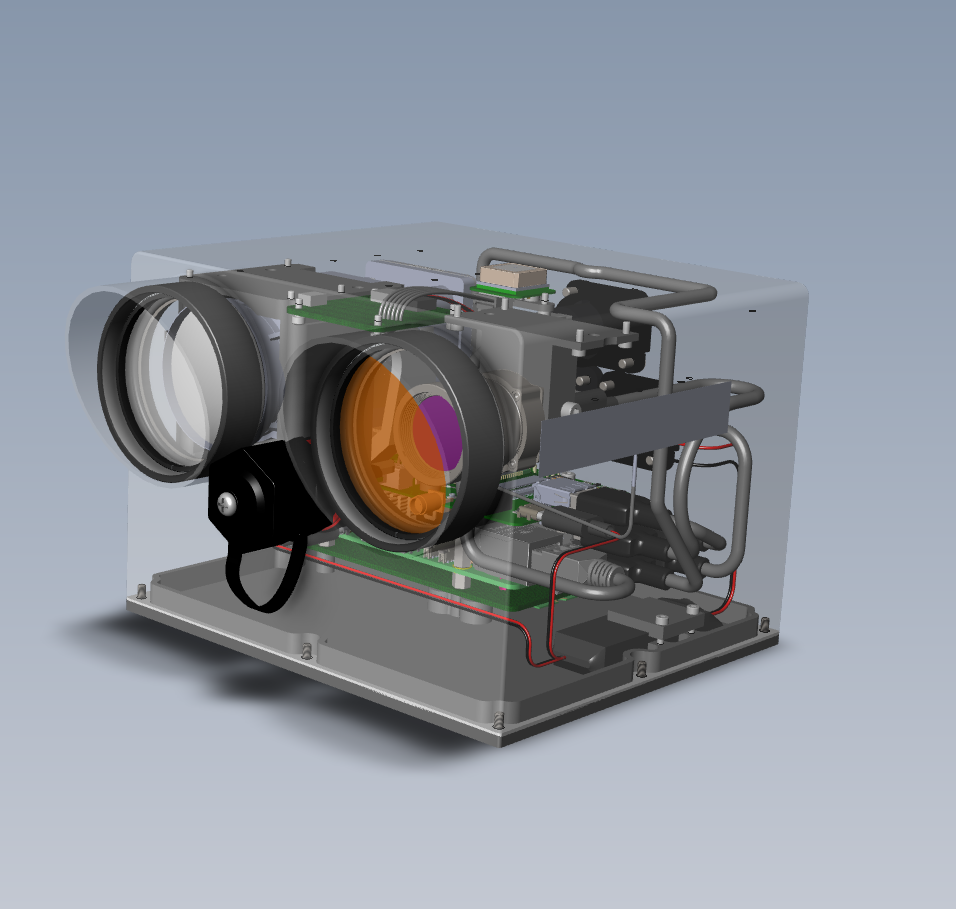
Arlumen designed the vision system integrated into the CamIA solution. In particular, our teams carried out a thermal and optical design study of the multispectral camera to validate its conditions of use and select compatible components.
Our customer's aim: to protect the environment by designing a product that is itself eco-designed.
To achieve this, our team responded to the need to design :
- an upgradeable enclosure
- with low energy consumption
- using French or European components as much as possible.
Optical system features :
- The detection system can integrate up to 2 cameras in 3 wavelength ranges: visible, near infrared (SWIR, up to 1.7µm) and thermal (TIR, 8µm-14µm) and/or use data from external cameras.
- n the visible spectrum, the system must be able to detect an object measuring 1.7m x 0.6m at a distance of 2km, or 3m x 3m at a distance of 10km (nominal resolution), and be equipped with a system for removing any doubt (optical and/or digital zoom). In other spectral bands, the target resolution should be close to that of the visible range.
- The system must have a horizontal field of view of at least 10° at nominal resolution.
- The operating limits of the main components (electronic board, thermal camera and visible camera) can vary from -25°C to +60°C.
- The system must be watertight and able to dissipate the thermal power of several elements.
- The mass is limited to 1kg, with restricted dimensions in width and height (150 x 110mm), so that it can be usedon various supports (drone, fixed mast, aerostat, etc.).
- The system's designoptimizes reparability by placing each component in its own place, independent of the others.
- Cameras and portholes are fully interchangeableto maximize the possibility of different configurations. The electronic board can be adapted as required.