What is infrared thermography?
Infrared thermography is an optical principle that measures the radiation (or luminance) of an object or body to determine its temperature. This radiation depends on the heat and material of the object observed.
Infrared is an electromagnetic wave whose frequency is lower than that of visible light. Infrared wavelengths lie between the limit of the visible range (approx. 0.7 μm) and the microwave range (approx. 1 mm).
The infrared spectral range is invisible to the naked eye. This is why a thermal camera is needed to observe this radiation.

What is a thermal camera?
A thermal imaging camera is an optical instrument made up of specific materials that can be used to observe a thermal image. Unlike a conventional camera (for visible light), a thermal camera has lenses and sensors adapted to infrared wavelengths.
It is dependent on the environment in which it is located. For example, an infrared camera works less well in water, because the rays emanating from an object are not propagated.
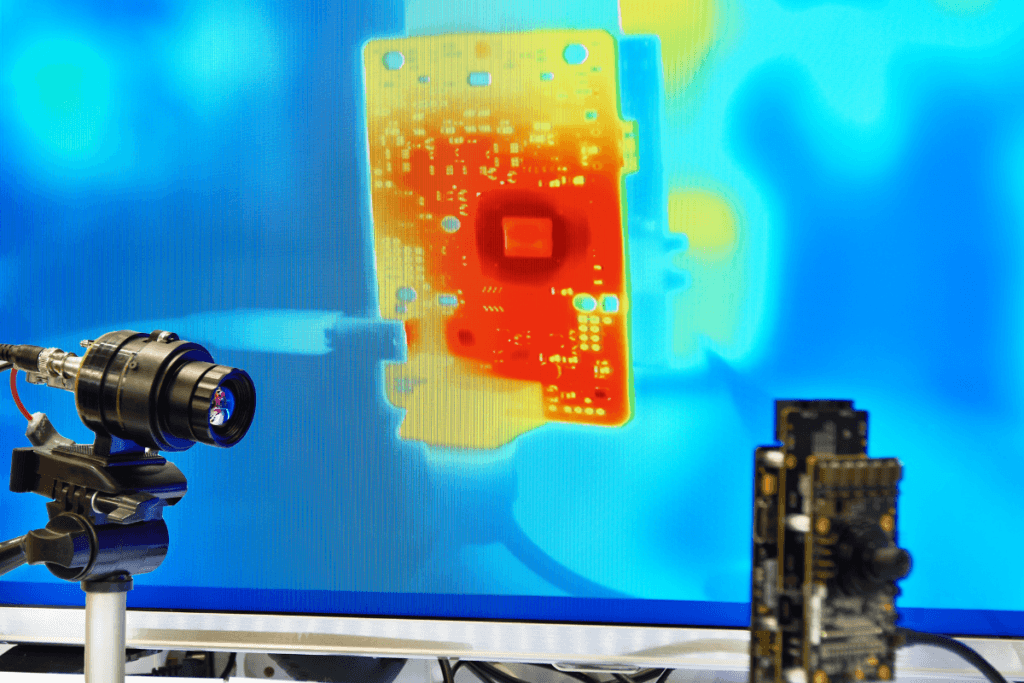
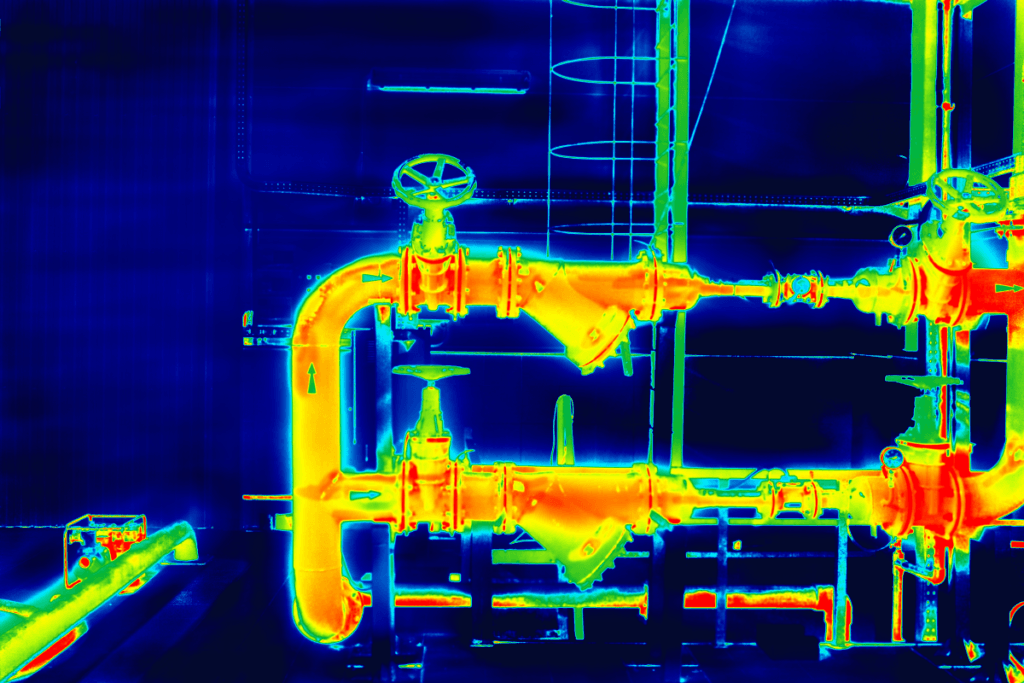
On an infrared thermal camera, light intensity is converted into a color scale to illustrate temperature differences and facilitate interpretation.
Depending on the device, we can customize this color scale to highlight the cold or hot zones of an environment, a product, a body...
Image quality depends on the type of camera. Quality has improved over the last 20 years.
History and discovery of infrared thermography :
The English astronomer Sir William Herschel is credited with discovering the optical concept of infrared thermography. Wondering whether each color had the same warmth, he came up with the idea of conducting an experiment. He decomposed white sunlight using an optical prism and applied it to a thermometer.
Result: temperatures rise steadily from violet to red, passing through the other colors of the rainbow.
Red appears as the hottest color on the thermometer. Herschel also discovered that an imperceptible zone beyond red was much hotter than all the others.
He named this zone, invisible to the naked eye, infrared (from the Latin infra: "lower"). It was Herschel's experiment that demonstrated that heat can be transmitted without visible radiation.
Did you know?
The word "thermography" comes from the Greek "thermos" meaning "hot" and "graphein" meaning "to engrave, to write". Thermography therefore means: writing heat!
What are the advantages of infrared thermography?
The advantages of infrared imaging include:
- Non-contact measurement
- Non-destructive measurement
- Access to the temperature of any object, material or living being
- Accurate to within 0.1°C.
- Measuring the temperature difference between two media
- Easy to transport (battery-powered camera)
- Independent analysis of all types of material
- Night-time measurements possible, no brightness required.
- Operates in daylight or in complete darkness
What are the uses and applications of infrared thermography?
Infrared optical measurement can be used to measure large temperature ranges as well as more precise variations down to 0.1°C.
It is therefore used in many sectors:
- medical
- industry (industrial process control: electronics, foundry, glassmaking, chemicals, etc.)
- defense
- protecting sensitive sites
- relief
- building (energy performance)
What are some practical applications for infrared thermography?
This optical technology enables :
- Detect hot or cold spots on a surface or body...
- Identify thermal bridges (buildings, insulation, energy diagnostics)
- Identify leaks from hot or cold sources (gas, material...)
- Finding and rescuing people at sea (recovering warm bodies)
- Protect sensitive areas with defensive thermography (presence detection)
- Aerial and terrestrial thermography with infrared cameras on drones
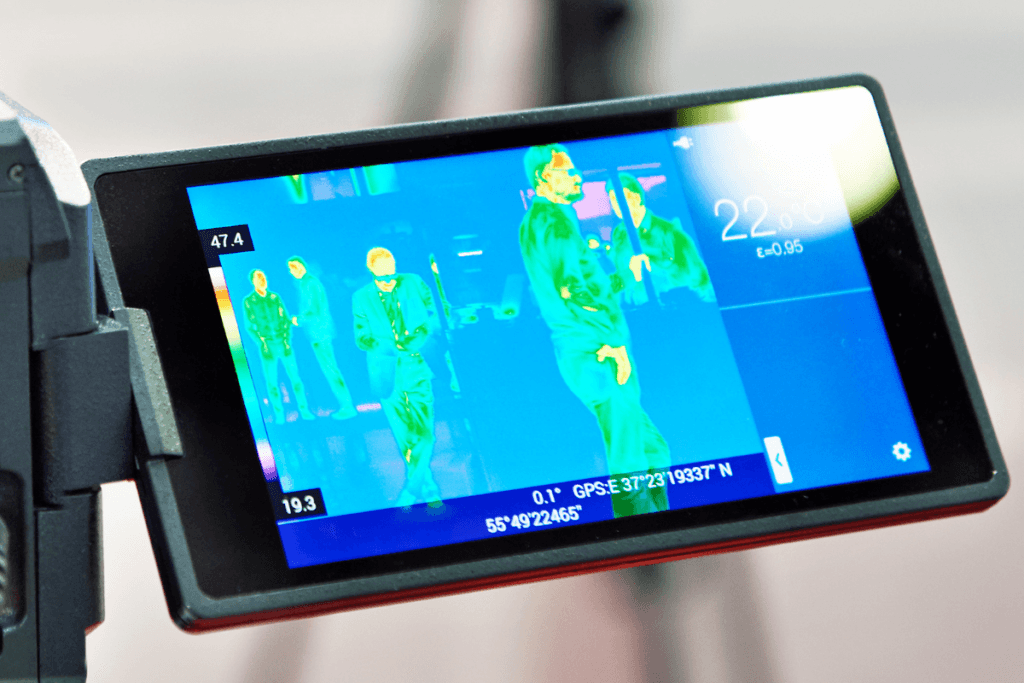
- Detect faults on electronic boards and IT products
- Thermal overheating detection
- Precise temperature measurement (foundries, steelworks)
- Non-destructive testing with infrared inspection thermography
- Analyze pathologies using fast, non-invasive, non-contact cameras.
An optical design project for near-infrared, visible and thermal cameras
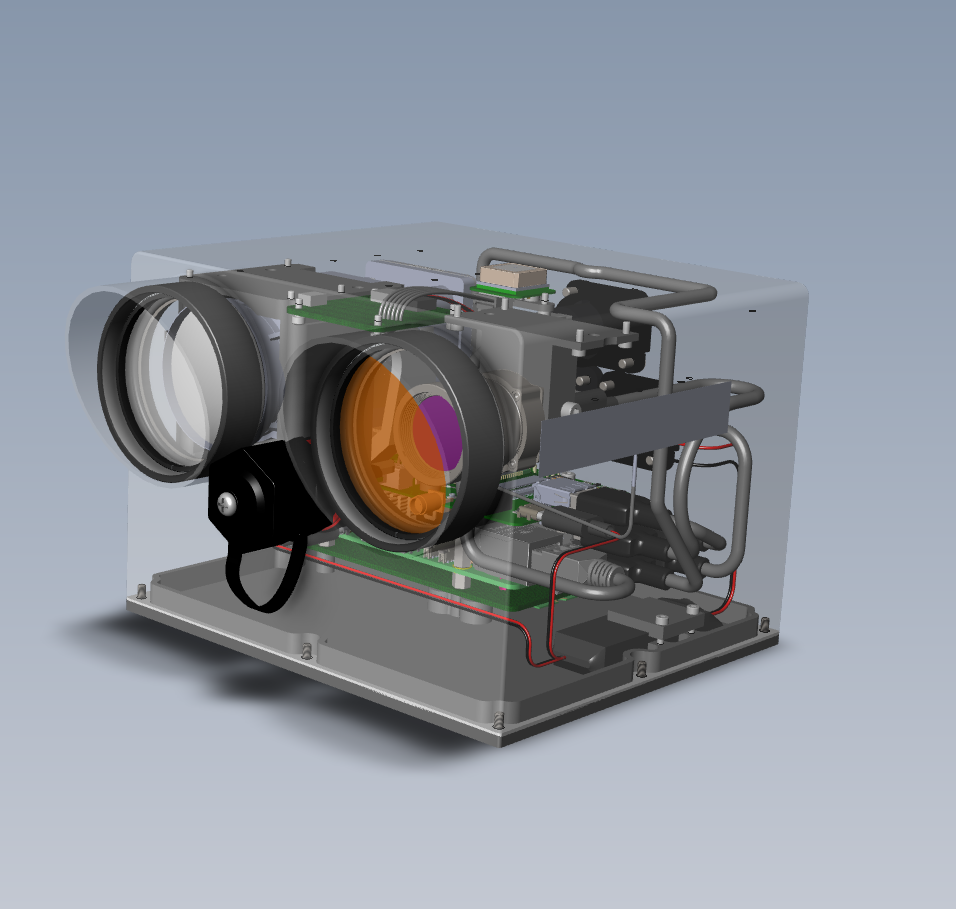
AzurIA entrusted Arlumen with the mechanical, optical and thermal design of their CamIA multispectral camera. This intelligent detection and warning system features on-board AI that detects natural hazards and dangerous situations (starting fires, rescuing people at sea, marine pollution, etc.).
The detection system can integrate up to 2 cameras in 3 wavelength ranges: visible, near infrared (SWIR, up to 1.7µm) and thermal (TIR, 8µm-14µm) and/or use data from external cameras.
Custom infrared cameras from Arlumen, a company specializing in optical systems
Our teams of optical experts design and build your custom thermal imaging cameras. Contact us for your :
- Infrared camera design
- Camera integration
- Lens sizing
- Lens sizing
- Coupling infrared and conventional cameras
- Heat dissipation calculation
- Thermal study