In March 2022, NASA completed the first stages of calibrating the mirrors of the James-Webb telescope. These initial adjustments have produced a clear image of a star in the Big Dipper. Building such a telescope requires precise steps to define its architecture and ensure that it meets scientists' objectives.
Whether it's for a multi-billion dollar telescope designed by NASA, or for smaller-scale projects, the same method applies. At Arlumen, we follow the same steps as NASA engineers when developing and implementing optical systems. Each step has its own importance and specificities, which we will explain in detail below.
Step 1: Feasibility study
This stage involves sizing and defining the system's functionalities in relation to requirements.
NASA
Upstream studies for the development of JWST (James Webb Space Telescope) were aimed at imagining a successor to the Hubble Space Telescope (launched in 1990, originally scheduled for replacement in 2005). The aim of these scientific instruments is to understand and explain the origins of planets and galaxies throughout the universe. As is often the case, they enable us to explore areas that have not been accessible to date in terms of existing knowledge and technologies.
For the JWST project, all these considerations pointed towards a telescope working in a fine spectrum from the visible (red) to the far infrared (0.6 to 24 µm). Atmospheres and dust, due to their optical scattering and absorption, are limiting factors in the visible bands. The study phase enabled us to define the instruments to be developed and to size the associated resources.
Arlumen
In its projects, Arlumen supports its customers in defining the specifications and means associated with their needs. The feasibility study helps limit development risks and costs. It gives rise to precise, detailed specifications that determine a maximum number of criteria and target performances:
- Physical dimensions
- Performance (sensitivity, speed, power consumption)
- Techniques (measurement, imaging, lighting)
- Standards to be met
- Costs
The technical, environmental and financial contexts guide the development of the next design phase.
Stage 2: Design
This phase is broken down into several highly technical stages, which define the technical characteristics of the desired product (definition file). This file lists the elements and techniques required to meet the specifications
NASA
Numerical simulation
Numerical simulation is used to build and calculate optical sub-assemblies. As part of the development of the James Webb telescope, this stage was used to define the optimum mirror size and the telescope's measurement and observation methods.
Mock-ups and tests of sub-functions
Mock-ups are made during these phases to verify and refine calculations experimentally.

1/6 scale model of the optical section created to validate the architecture of the future telescope. Source : NASA
Final design
Engineers use special software to model and assemble the various components virtually. This is known as Computer-Aided Design (CAD). This stage enables the position and dimensions of the various product components to be fine-tuned.
The thermal dimension in the telescope's development has reached proportions that have mobilized considerable ingenuity.

Thermal protection for the JWST telescope. Source : NASA CC
Arlumen
Digital simulation
During this design phase, Arlumen relies on its optical experts. In particular, they use Zemax software when a project requires optical simulation.

View of an optical simulation with ZEMAX software. Source : Arlumen
Mock-ups and tests of sub-functions
We also carry out tests to ensure that products function correctly and comply with specifications.

Source : Arlumen
Final design and design file
Arlumen's experts use specific, high-performance software to carry out this design, such as SolidWorks CAD software. Optical and mechanical models are superimposed to check dimensioning.
Managing thermal effects is essential in the integration of photonic solutions. At Arlumen, we design heat dissipation systems to ensure the proper operation of our customers' devices (LEDs, LASERs).

Source : Arlumen
The calculation steps are used to determine manufacturing constraints and tolerances. During the design phase, these results are distributed to the various system components. (materials, spacing, curvature, orientation...).
Technical watch and component verification
Technical watch enables us to identify components that can meet the technical specifications of the project. As part of the project to produce light sources for the Lighthouses and Beacons, the Arlumen teams were confronted with the limits of certain components (LED efficiency, current drivers), and were fortunately able to take advantage of the arrival on the market of components that were sufficiently mature and efficient to meet the requirements of the principals.
Thanks to this phase of monitoring technological developments, Arlumen brought a highly innovative expertise to the project. At the end of this phase, a design file is drawn up. It includes the various drawings and diagrams produced, as well as an assembly file including the procedures and controls to be implemented during manufacture.
Stage 3: Manufacturing

NASA
Reflecting the scale of the project, NASA assembled the James Webb telescope in a huge clean room. A clean room is a room in which the dust level is very low.
It is controlled to limit deposits on optics. Equipment and personnel entrances and exits follow strict procedures to limit pollution: cleaning, special clothing (overalls, gloves, headgear, masks).
The giant JWST mirror in NASA's Goddard Space Flight Center's clean room. Source : NASA CC
Arlumen
It is at this stage that the product takes shape, using our state-of-the-art equipment. The various elements and components are supplied by a network of partners and distributors selected by Arlumen. Different people may be involved (optical or mechanical technicians, electronics specialists, etc.) depending on the requirements of the manufacturing process: mechanical/electronic distribution, EMS, machining, molds, lens manufacturing, etc.
Specific items are checked on receipt. Monitoring is carried out by the purchasing team, using an ERP system. This is initially fed by the BOMs of the Design Office. The team of technicians then proceeds with assembly according to the plans and procedures established during the design phase.

These phases are carried out in clean rooms for optical systems that are highly sensitive to pollution.
Arlumen expert performing a sensitive optical manipulation in a cleanroom. Source : Arlumen
Step 4: Focusing
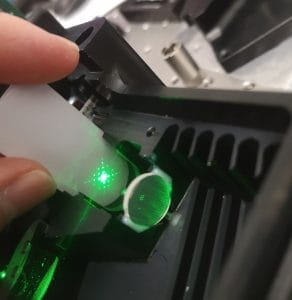
Next comes the fine-tuning phase. This consists of adjusting the various components, aligning them and finding the operating points. Adjustment and measurement benches are deployed. If necessary, simulations are run to understand as many phenomena as possible.
At the end of the development phase, the system is characterized by means of a test plan which describes the method used to check all the criteria defined beforehand (during the design phase). These criteria are measured and recorded in a test report. Tests can be carried out in specific environments close to the operating environment.
In the case of the telescope, specific enclosures have been built to check operation in space (high temperature range, vacuum, radiation). Final validation tests are carried out in conjunction with the customer, and are known as factory acceptance tests.
Step 5: Deployment
NASA
This is a rather exotic and spectacular phase for the JWST. The telescope is transported by rocket into space. The deployment phase is then carried out remotely by engineers and scientists. They adjust the elements from earth to calibrate the mirrors.


Schematics of the James Webb Space Telescope deployment in space. Source: European Space Institute
Arlumen
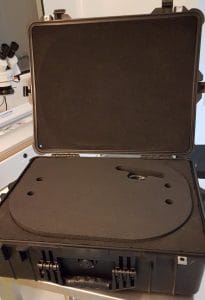
The product is then shipped to the customer for installation. Special crates are used for transport, ensuring optimum protection of the optical systems.
In fact, Arlumen designed a customized transport box to protect a star simulator. Once the product has arrived at its destination, it is tested under real-life conditions at the customer's premises, with the support of our teams.
Transport case for optical systems with custom-made protective foam.