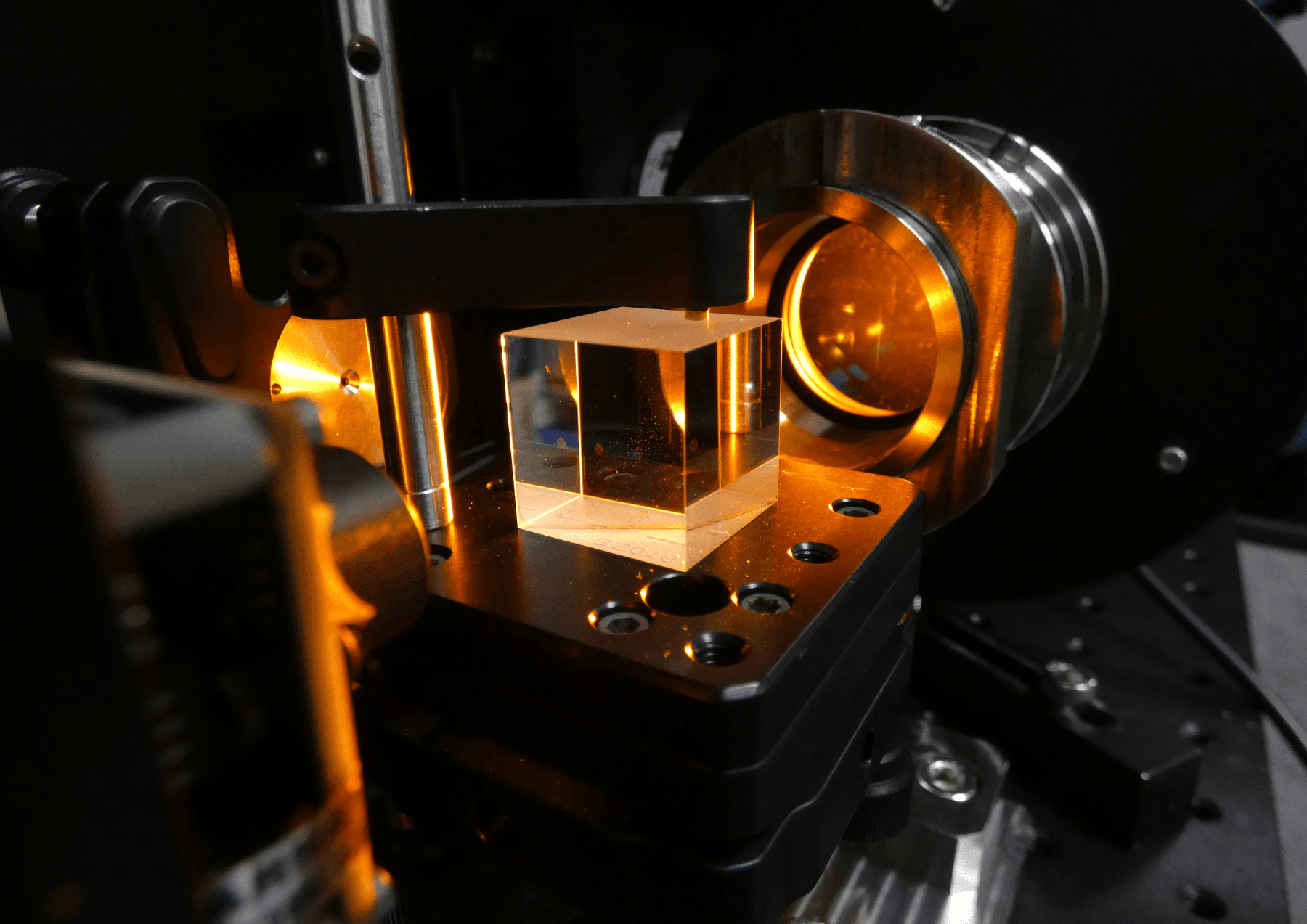
Whether for medical, biological, semiconductor or space exploration applications, Arlumen's optical engineering provides its customers with state-of-the-art equipment for surface analysis, measurement or environmental simulation, as illustrated by three recent achievements.
Optical engineering: development of a 2-photon endoscopic head
As part of its expertise in optical engineering, Arlumen was asked by a company specializing in biological and medical equipment to produce a miniature two-photon endoscope head. Custom-designed by the photonics company according to the customer's specific constraints, these endoscopic heads are innovative in their compactness and level of optical performance.
Arlumen has mobilized all its optical engineering resources to design this endoscopic head. With a diameter of 2.5 mm and a length of 9.5 mm, it features a single-mode optical fiber bundle with a core diameter of 2 µm and a numerical aperture NA = 0.35.
Optical expertise: design of an apochromatic collimator for non-contact measurement and identification of surface defects
Arlumen's optical engineering has also been mobilized to design an apochromatic collimator and longitudinal chromatic objectives with large numerical aperture. Designed for non-contact measurement in the semiconductor field, this achromatic collimator has a focal length of 200 mm, a residual chromatism of less than 25 µm in the 550-800 nm range, a pupil diameter of 36 mm and a wide field of view (20 mm). To complement this collimator, Arlumen has also produced lenses with high longitudinal chromatism but no lateral chromatism, for a 36 mm focal length and a high numerical aperture of 0.50.
The result of Arlumen's optical expertise, this type of collimator coupled with a chromatic lens is used for multi-point dimensional and surface topology measurements with instantaneous altitude measurement on a 3.6mm long line.
Competing products more frequently combine a collimator with an interferometric lens. However, this method does not give an instantaneous altitude value, and requires a large number of images to be taken at different altitudes, with a constant measurement step in Z smaller than the wavelength. This generally requires Piezoelectric positioners, the images then being processed pixel by pixel to reconstitute a 3D map of the area under analysis. The apochromatic collimator designed by Arlumen is sufficiently universal to be used with these interferometric lenses if required.
Optical engineering: design of a Star Optical Simulator (SOS)
In a completely different field, Arlumen's optical engineering was called upon to design a Star Optical Simulator (SOS). This simulator is used to fine-tune the navigation camera (NAVCAM) on the JUICE orbiter (Jupiter Icy Moon Explorer), whose mission is to study Jupiter's Galilean moons: Ganymede, Callisto and Europa. The spacecraft is scheduled for launch in June 2022 and will reach Jupiter in October 2029.
The SOS consists of a Simulator Electronic Box (SEB) and a Stars and Jovian Moons Simulator (SJMS). It includes a custom-built electronic board, which powers 3 high-dynamic, high-stability fiber-reinforced LED light sources. The SJMS is also equipped with specific custom optics from Arlumen's expertise, designed to collimate the light from 3 fibers connected to the SEB. It uses 3 lenses made by Arlumen and inserted in a titanium mount. Each lens is coated with specific anti-reflective layers to limit stray light. This optic is designed for use under vacuum, and target specifications must be achieved in the -40 / + 70° C temperature range.
Arlumen is delighted to see its optical expertise contributing to space exploration projects.