One of our core competencies is to accompany our customers from the design of an optical system through industrialization to mass production. Over the years, the Arlumen team has acquired particular expertise in a key stage in the development of a product that meets end-user expectations: miniaturization.
What's the point of miniaturization?
Of course, when we talk about the "miniaturization" of an optical system, we're primarily talking about its size.
The advantages it brings meet a number of challenges:
- The compactness of a system means that, for an equivalent volume,technical and economic performance can be optimized (whether we're talking about a light source, an optical sensor or an imaging system). In other words, by miniaturizing, we fit more functions into a given volume. This is particularly useful for applications in confined spaces, such as space travel, underwater exploration and certain medical technologies.
- Miniaturizing a system also means reducing itsenvironmental footprint. Indeed, a smaller optical system means fewer raw materials used; it also means lower weight and energy consumption (essential criteria for all embedded systems).
But in Arlumen's approach, miniaturization is part of the development cycle of an optical system. It is therefore a step that will also provide an opportunity to work on the system's stability and robustness, so as to be able to turn it into an industrial product with repeatable, long-lasting performance.
What are we talking about?
The miniaturization of a system will call on all the technological skills of Arlumen's photonics expertise, and is part of an iterative process.
At the end of an initial design and prototyping phase, the customer will have validated the optical system's functionality and performance. The design can then be fine-tuned to meet the demands of miniaturization. At this stage, for example, we'll be looking to optimize optical paths to make them more compact, using clever concepts.
In the same spirit, we can also specify the choice of certain opto-electronic components to meet the challenges of energy efficiency or heat dissipation, or to recover a maximum signal when using ultrasensitive detection. The positioning of components will also take these requirements into account (for example, to decouple heat sources as far as possible from the rest of the system), and will also anticipate ease of assembly.
It is also at this stage that the selection of components can be reviewed in order to reduce their number (and/or cost). As our team is constantly on the lookout for new technologies, our engineers are up to date with the latest developments from component suppliers, and have developed in-depth know-how in finding the components with the best cost/performance/robustness trade-offs.
All these choices can then be confirmed by system simulation (optical simulation with Zemax, mechanical and thermal simulation with Solidworks, electronic simulation with LT Spice).
Finally, once these simulations have been validated with our customer, the next stage will be prototyping, where the expertise of Arlumen's team of photonics technicians in optical alignment, optical bonding, adjustment and calibration of optical systems will come into play.
A few examples

Development of an Optical Processing Unit for LIGHTON
From lab manipulations to a small cube you can hold at your fingertips
Application: artificial intelligence and high-capacity calculations. We worked on the optical core (source/optics/detection) and more particularly on :
- source optimization
- beam shaping
- optimized detection
- stray light reduction
The result: volume divided by 1000 in 9 months
- t0: lab manipulator 50 cm x 50 cm x 20 cm
- t0 + 4 months: 1st integrated proto 13 cm x 9 cm x 6 cm
- t0+ 9 months: 2nd proto 5 cm x 5 cm x 2 cm
Optical core (source/optics/detection)
- Source optimization
- Beam shaping
- Optimized detection
- Stray light reduction
Optical computer for AI 2.10¹² operations on one clock cycle, with very low energy consumption
Machine learning, data processing, image classification, action recognition in videos, language models, complex numerical simulations, graph-structured data, ...
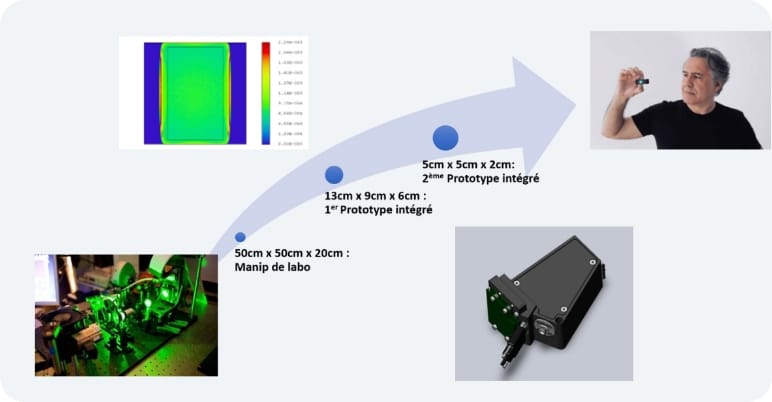
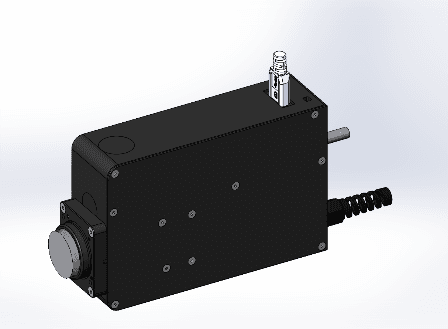
Photo-acoustic imaging system for DEEP COLOR IMAGING
Application: medical imaging / high-resolution 3D in-depth imaging.
- Technology used: Microscopy
- Key features expected of the system: enhanced performance and robustness
Challenge for our team and challenge met: speed of execution and adaptation
Prototype 2 t0 +16 months (Right)
Arlumen's scope of activity: consulting, optical, mechanical, electronic and IT design, manufacturing, hardware + HMI programming, fine-tuning, installation.
- 50µm resolution
- Large depth, large field of view
- 10mm deep
- Field of view 14 x14 mm
- Spectral separation of chromophores, Melanin, Oxyhemoglobin, Hemoglobin, Lipids...