The flexibility of LEDs allows Arlumen to deploy its optical engineering to a wide range of sectors. Highly energy-efficient, particularly compact and requiring little maintenance, these optronic devices have become a central element in the equipment designed by the Brest-based optical expert. An overview of the Led...
LEDs for optical engineering
Arlumen has been using LEDs since its creation in 2009. Leds, for light-emitting diode, are a widely-used component. It is an optronic device that emits light when an electric current is passed through it. Arlumen's teams, specialized in optical engineering, have a perfect command of LEDs and are frequently called upon to use them in projects, for several reasons.
Firstly, the optical engineer can shape the radiation emitted by the LEDs to suit the needs of the customer's project. He can work on focusing to direct or widen the flux on a precise area. He can control the homogeneity of the flux, and select one or more ranges of the light spectrum: from UV to infrared to visible. It can also work on optical flow efficiency. This stage of optical design and engineering is generally carried out using computerized optical simulation and manufacturing tools.
The power supply is a key element in the design of LED-based lighting systems, and is studied, dimensioned, integrated and prototyped accordingly. Depending on the system's application, several criteria come into play: stability, efficiency, synchronization and cost. Modeling is also practiced by optical engineering specialists, prior to prototyping proper.
The mechanical integration of optical and electrical assemblies also includes an analysis of heat dissipation. Although LEDs emit less heat than conventional incandescent bulbs, they generate thermal energy that needs to be dissipated. During this design and optical engineering stage, the engineer also takes into account the aesthetics of the system, as well as its integration and protection in its final environment. For example, a system subjected to high pressure and a salty environment will need to incorporate devices that enable it to withstand these conditions while retaining all its functions.
Integration of LED-based optical systems in a wide range of environments
Thanks to their versatility, Arlumen has integrated LED devices into numerous applications.
- Marine beacons
This is particularly true of the marine beacons designed by Arlumen. They use high-power LEDs and secondary optics to direct the beam on a horizontal axis. Replacing halogen optics, this equipment significantly reduces energy consumption and is far more durable.
- Powerful surf lamp
Still in the marine world, Arlumen has designed a portable light for night surfers for the Black Swan company. Designed in collaboration with several companies in Brittany, this is probably the most powerful headlamp in the world. It is also totally waterproof, has a 90-minute light duration at maximum power and can be used at 3 different distances.

- Microscopic observation
At a much smaller level, Arlumen's optical engineers have designed LED-based microscope illumination systems. Intended to improve sample observation, these devices are used in industry and research (semiconductors, environment, health). Highly compact, they feature specific spectral and energy characteristics (no optical filtering) and benefit from a very favorable life-cycle/cost ratio.
- Optical sensors
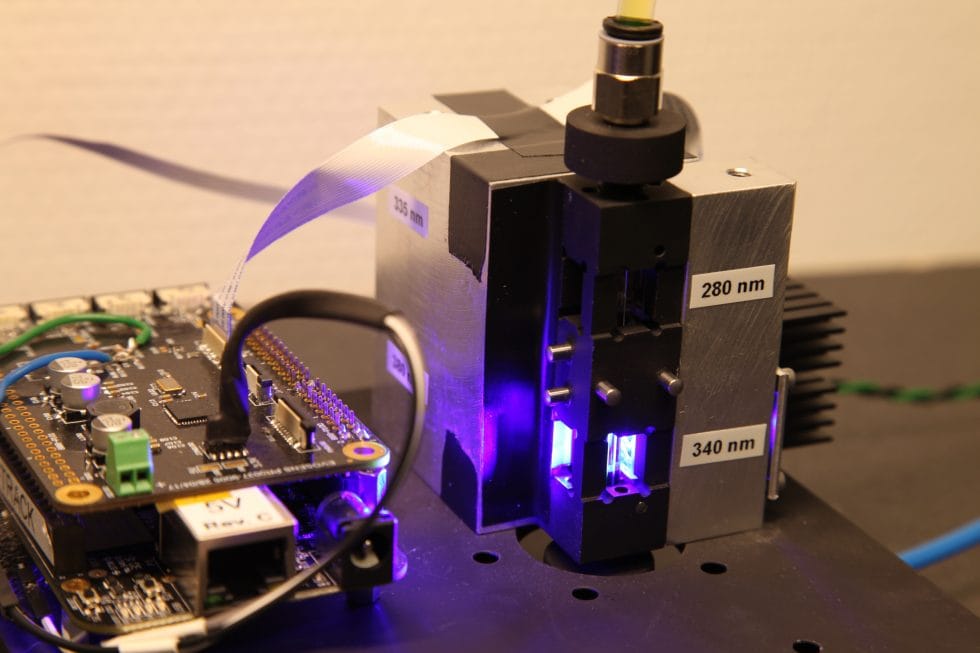
The environmental, medical and food industries often use optical sensors to measure the concentration of products or components in solutions. These measurements are made by fluorimetry, spectrometry or colorimetry, and require a light source provided by the LED(s) selected. Arlumen has designed various LED-based systems for this purpose, whose robustness, compactness and spectral characteristics (monochromatic or a wide choice over the UV-Visible and IR range) make them highly interesting. The result of Arlumen's otic engineering, these systems also boast high energy density, good response times, long life and low maintenance.
- UV hair clip
Still using LEDs, the optical experts at Arlumen have also designed a UV light clamp for a cosmetics company, capable of producing a photo-reaction on a hair care product. With its high energy density, fast action and compact size, this system brings an innovative technological component to the cosmetics sector.
Optical engineering for decontamination
This year's 2020 health crisis has also highlighted the potentially significant need for air, water or surface disinfection. Thanks to UV LEDs, Arlumen's optical engineering can be used to design effective decontamination systems at low cost (no consumables, little energy required). UV light is particularly effective against viruses and pathogens of biological origin. A problem that Arlumen would be delighted to tackle as part of a project benefiting public health.
As these examples show, compact, flexible and inexpensive, LED displays can be of interest to a wide range of sectors. If you have any questions, please don't hesitate to contact us.